The Way of Showing Pani Poni Dash!
Director: Akiyuki Shinbo, Series Director: Shin Oonuma,
Opening Director: Tatsuya Oishi, Episode Director: Yasuo Ejima
Oonuma-san, Oishi-san and Ejima-san, these three men have been in charge of directing nearly half of all Pani Poni’s episodes. Together with Director Shinbo, all of them discussed today about their own directing style. | |
|---|---|
The Exceptional Way of Making Unusual Pani Poni | |
It’s a bit sudden, but what are your thoughts about finishing the work, Director Shinbo? | |
Shinbo | I think this time we had really free hands with our work. It felt like a very good way to show personalities of several people, starting with the three men here today: Oonuma-san, Oishi-san and Ejima-san. I think that factor granted the work its immense strength. |
We spoke to Oishi-san and Oonuma-san already in the previous guidebook, but this time Ejima-san is with us for the first time. Ejima-san has directed many of the episodes produced by Studio Pastoral. | |
Ejima | I originally had no previous connections to people at Pastoral, but I was introduced to them by people at SHAFT. |
Shinbo | There aren’t that many directors at Pastoral. So as an ace up our sleeve, we had Ejima-san go up to them (laughs). |
Oonuma | At the time I saw the finished video of Episode 4, which was Ejima-san’s very first directional work with us, I still had a completely different image of the story from the storyboard. But I was surprised by the finished episode, as in “Was it always this funny?”. |
Ejima | It was probably because of the exchange between ideas in animation. I explained the policy of including things you wanted to see by telling the animators “If there’s something you consider funny, it’s okay to change it to that way”. |
Oonuma | As I thought. Rather than making any firm decisions, if the animators wanted to do some jokes, we let them do so, which is the entire direction we had for Pani Poni. This isn’t limited only to animators, but also to directors, as the key is to bring out the potential of each person. |
Ejima | In that sense, I was only riding on Pastoral’s staff, which really helped me out. |
Oonuma | I believe there are a lot of animators who think like “I have to do the things handed over to me exactly as they were given to me”. With Pani Poni, I wanted to free them from all these restricting shackles. Don’t wanna do it like this? Then let’s do it like that. Like a gradually accelerating engine, animators got out of their shackles little by little. |
Ejima | That’s why in the episodes I was in charge of, everyone was doing all sorts of stuff, so there were several things I wasn’t able to keep track of (laughs). Honestly I just told them “Do what you wish, do what you wish”. When I once asked to “do it like this”, all the staff at Pastoral were kind enough to fulfill my request, and with that, we really did a great job. |
While Giving Mutual Motivation | |
Oishi-san and Oonuma-san, looking at Ejima-san’s direction style, what are your thoughts about it? | |
Oishi | It’s all over the place... (laughs) |
Ejima | Eeh, you’re the last person I want to hear that from (laughs). |
Oonuma | All over the place, as in, everything is in high spirits. When I watched Episode 4, which was directed by Ejima-san, it affected me deeply from the very beginning. Seeing Episode 4, I overcame with the feeling “Damn, I gotta not lose to him”. |
Shinbo | Wasn’t it Episode 4 that got early on high praises from Hikawa-san? |
Oishi | Seeing Episode 4 got also me energized. Something like “Shit, I’ll defeat him!” (laughs). |
Ejima | But when I was working on Episode 4, Episode 1 hadn’t been finished yet, and honestly, I had no clue what kind of an anime this would turn out to be. So, we were in the middle of making Episode 4, and when Episode 1 was finished, I gave it a look. There I saw the way they used chibi characters, and thought to myself “Oh right, so that’s how it goes”. And then I thought “I gotta do more of them”. |
Shinbo | Episode 1 was all high spirits by being packed with various elements, which had me thinking “We got 26 episodes on our hands and we’ve gone this far with just Episode 1, I wonder if we’ll be alright from here on out”. At the time Episode 4 came out and easily surpassed the tension of Episode 1, I was really relieved. |
Oonuma | That’s right. It seemed that many viewers got hooked up with the show after watching Episode 4. And then, next up was Oishi-san’s Episode 6, which he directed with an inimitable touch. That’s why I went like “This is too good!”, and made Episode 8 (laughs). |
Ejima | Watching Episode 8 turned my views on the show upside down, and had me thinking “Woah, so we do really have to go this far!” (laughs). |
Oishi | Compared to Ejima-san and Oonuma-san, I reflected my work as in “What should I do”. Both of them are hot stuff (laughs), so I felt like wanting to give my episodes a bit of cool vibes. And, because Episode 4 was so high in quality, I thought “If I can beat this first, we can see how to move forward!” |
Ejima | You already beat us with Episode 6 (laughs). |
Oonuma | Whenever I watch Oishi-san’s episodes, I’m even more motivated on wanting to show my own style. If Episode 8 was something I made in order to surpass Episode 4, I created Episode 16 and episodes onwards rather on the premise of showing my own style. At the beginning, I had full hands with fleshing out everyone else’s potential, but afterwards I started adding my style in. However, in terms of the direction I was heading to, I was determined not to follow Oishi-san. Even if we fought in the same ring, there’s no way I’d win (laughs). For instance, I create scenes by increasing the amount of colour and elements in them, whereas Oishi-san goes with the simple and dynamic way. |
Ejima | Aah, well in that sense, Me and Oonuma-san may have the same artistic style. |
Oishi | The most memorable episode for me and Oonuma-san is probably Episode 16. It really shows Oonuma-san’s style. I think Oonuma-san’s way of using digital tools is amazing. While Oonuma-san is all in digital, I’m trying out analogue techniques. Also, each episode in “Pani Poni” feels like something Oonuma-san could’ve directed. |
Ejima | Digital is pretty mainstream, isn’t it? |
Oishi | And so, it looked like Ejima-san’s and my episodes were full with different accessories. |
How One Incorporates Parody | |
Shinbo | But everyone has a respectively different directing style. With Oonuma-san and Ejima-san, they have the style of gathering everyone’s strength together. Oishi-san has strengthened my image that everything doesn’t need to be full of parodies and jokes, and I feel he hit a bullseye with his style (laughs). |
Oishi | It’s pretty surprising that there’s only few parodies in my episodes. That’s why when even the few parodies get rejected due to restrictions, I can’t help but be disappointed and scream “Aah!” (laughs). ...Speaking of which, wasn’t the very first restriction on a joke in Episode 4 (laughs)? |
Ejima | Cough, cough! |
Oonuma | That’s right, you’re talking about Episode 4’s Superhuman from Mikawa (laughs). |
Ejima | At the storyboard stage, he still looked like Tokugawa Ieyasu, but in the animating stage his figure started to look more like the protagonist of a certain manga, and restrictions were made (laughs). However, the aura of his colours remained the same. |
Oishi | Even in my Episode 6 there were considerable amounts of restrictions on the parody jokes, which got me thinking “Man, copyright walls sure are strict”. However, Ejima-san had pigeons flying and a song that went “Ma~hoho” in Episode 10. That made me laugh, but since I thought how “parody is strict”, seeing this type of thing allowed made me frustrated (laughs). |
There was even a joke about the commercial where a huge tree comes into view. | |
Shinbo | Both of these jokes are typical for Ejima-san’s episodes. |
Ejima | Wasn’t it you, the Director, who told us to do them (laughs)? |
Shinbo | Nope, dunno about them. Did I say to do them (laughs)? |
Oishi | I recall that higher-ups got slightly angry after seeing those episodes. We take too much liberties in our work, they said (laughs). |
Shinbo | There are plenty of jokes in Ejima-san’s episodes, but it looks like half of them get slaughtered while the other half remain untouched (laughs). |
Oonuma | It certainly feels like every scene in Ejima-san’s episodes has a joke or two (laughs), which probably makes it troublesome for the person checking them. |
Ejima | Can’t say how it’s for other people (laughs). |
Oonuma | I pack my episodes full of jokes, but I end up packing them with more and more niche stuff. That’s how I played safe most of time (laughs). It’s like I went full on underground (laughs). |
To Bring Variety of Personalities Together | |
I’d like to ask the following question from the Director. With many unique directors participating, was it difficult to bring them all together to do one Pani Poni anime? | |
Shinbo | First and foremost, we created one format. It was the same for each episode: the main part stars up with a cold open and an opening, various artworks are implemented as eyecatchers, and after the ending in B part, there’s a C part. That’s the format that came to be Pani Poni. We have worked with that style since the very beginning. Then, we thought that adding anything on the blackboard would be a plus. So even if the story delved into something completely different, the inserted eyecatcher has become a structure that can pull you back to the world of Pani Poni. On the contrary, to have people, who’d have fun with their work, make the things they’d love, a framework like this is needed. I personally wouldn’t control a work this way, but in order to create an environment for everyone to do their things in this anime, this format was necessary. |
Within that framework, people from various fields were able to give their all, I see. | |
Oonuma | The pace of the original work and the format that Director spoke about were instruments to make Pani Poni. Working with these instruments, us directors and animators gathered together and filled the anime to brim with our jokes. And that’s how Pani Poni Dash! came to be. |
Oishi | That’s why we don’t think our finished work is that far from the original work. |
Lastly, the Last 3 Episodes They Worked With | |
Well then, since at the end everyone was in charge of Episodes 24, 25 and 26, I’d like to hear about the production of those episodes. First off from Oishi-san, what were the challenges and joys of making Episode 24? | |
Oishi | For Episode 24, I borrowed a DVD of Shin His**** Shigotonin from the Director, and studied it. Personally, I’m not all that familiar with jidaigeki dramas. However, since I’m doing the episode, I didn’t want to make a fool out of myself in the eyes of jidaigeki fans, so I wanted to do a proper jidaigeki parody, even if it was a joke. And the Director paid particular attention to the bidding scene. We wanted to make it so that His***** fans could make a smile while watching it. Thinking about that, it was like I got more out of control the more I wanted to do this and that. |
Oota | Basically, a lot of scribbles on the blackboard. If retro games are Oonuma-san’s thing, majority of the mecha anime lines and others are mine (laughs). I also include references to TV shows that no one has watched, but when I afterwards check comments online the day after the episode airs, I found out that there exist people who know the reference (laughs). It’s quite funny. |
Oonuma | Also, Episode 24 Miyako is by far the coolest (laughs). |
Oishi | I was feeling that Miyako is way too unpopular. That’s why I was determined to make Miyako stand out in the story, and showed my commitment with this. Her character design is changed a bit, and has a refined feeling to it. |
Shinbo | But Oishi-san, in Episode 26, the key frame for the scene everyone gathers close up to Becky, didn’t you at first plainly forget to draw Miyako in? How did that happen after talking that much about “Miyako and Miyako”? (laughs) I felt this was something I definitely had to say (laughs). |
Oishi | My apologies (laughs). That was because I had filled up the quota of her screentime already in Episode 24 (laughs). |
Well what about Ejima-san’s Episode 25? | |
Ejima | Not gonna lie, since it was going to be the last episode I directed, I went with the plan of doing whatever I wished. Honestly, when working alongside Oishi-san and Oonuma-san, I just couldn’t find a way to beat them (laughs), and regarding to the jokes, I decided not to contemplate the thought “There wasn’t enough of them”. Ever since I’ve worked on episodes, I’ve been regretting that fact a lot (laughs). |
Oonuma | It looks like the tension at the workplace was disorderly high towards the end. |
Ejima | It was high. Until the film was up, I had no idea how the stuff we all worked with would turn out. “Pani Poni” has always that type of a stressful feeling to it, but it was especially with Episode 25, when we all felt “It was tough, but thank you very much” (laughs). |
Oonuma | In the midst of making Episode 26, (Kazuhiko) Oota-san watched Episode 25 and said to me “Uaah, it’s gonna be bad if we don’t work hard with Episode 26” (laughs). |
Ejima | And in Episode 26, just as he said, Oonuma-san worked hard and got carried away (laughs). |
Oonuma | The concept for Episode 26 is “wrap party” with the implication of “the work returns to be a manga”. Blackboards have comments from every staff member, and lastly, voice actors’ comments are fastened to the story. But it’s not a “Goodbye”, but rather “Good job”. The episode implies that Pani Poni will continue from this point onwards, but we’re now taking a short break with the line “good job everyone”, and by “returning it to be a manga”. In terms of individuality, I think the last 3 episodes of show’s latter half had an extremely beautiful flow to them. We thought that the viewers would agree with how the episode looks, so we were able to do Episode 26 without any pressure. |
Pani Poni Is Far From Over | |
Oishi | Pani Poni is a show that all directors gave an amazing facelift. I wouldn’t have learned all these new things anywhere else. |
Shinbo | Even though Episode 26 had just ended, we were already thinking how we would continue from this point on. We gotta do some great stuff (laughs). |
Ejima | But I’m all out of jokes (laughs). |
Oishi | The show got more intense as it progressed to the latter half, and Yuji Moriyama-san did an amazing job. |
Oonuma | Isn’t Moriyama-san a person who’s an originator of this kind of parody? I thought that his usual style of doing as he pleased was different with this show. |
Shinbo | What I found incredible with this anime is that no matter the joke, viewers were able to follow along. The level of understanding things you see is pretty high, after all. |
Oonuma | And internet’s power has grown in a large scale. People have had a great effect in the popularity with their Pani Poni databases and fansites, and I don’t think I can ever thank them enough. |
Ejima | Also, internet has taught me a lot of the things here that I didn’t know about (laughs). Fans even sent us postcards. |
Oonuma | We were really happy to receive feedback from the fans. That’s why we introduced plenty of postcards that were sent to us, and included words of encouragement from the website administer. I believe that’s how a work successfully communicates with its fans. It’s a section that’s definitely different compared to any anime released up to this point. |
Director, what are your thoughts now when looking back to the work? | |
Shinbo | I feel that this time around, I worked like a real director. I was reminded how fun it’s to create something with everyone’s help, or rather, manpower. And above all, I really wanna do Season 2. We still haven’t adapted the elementary school arc from the original work. TL's note: "Elementary school arc" refers to the plotline where Becky goes to study in an elementary school in the manga. The arc is covered in Volumes 6 and 7. |
Oonuma | There’s a lot we can still do. While at it, DVDs are still on the way to be released, and we’re in the middle of preparing additional jokes to them. For us, “Pani Poni” is far from being over! |
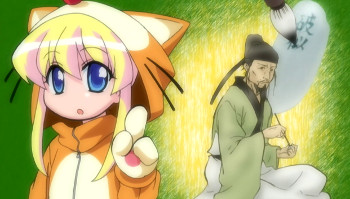 Episode 4 that gave motivation to Oonuma-san and Oishi-san. Not only was it a simply fun episode, but also incredibly significant in the sense instilling the “I can’t lose” competitive spirit among the group of “Pani Poni” directors. |
Tatsuya Oishi's Style Representative works: Tsukuyomi: Moon Phase (Direction, Storyboard), Tetsujin 28-go (2004) (Direction, Storyboard) etc. Worked on Pani Poni Dash! as the Opening Director, and overlooked the production of each episode. 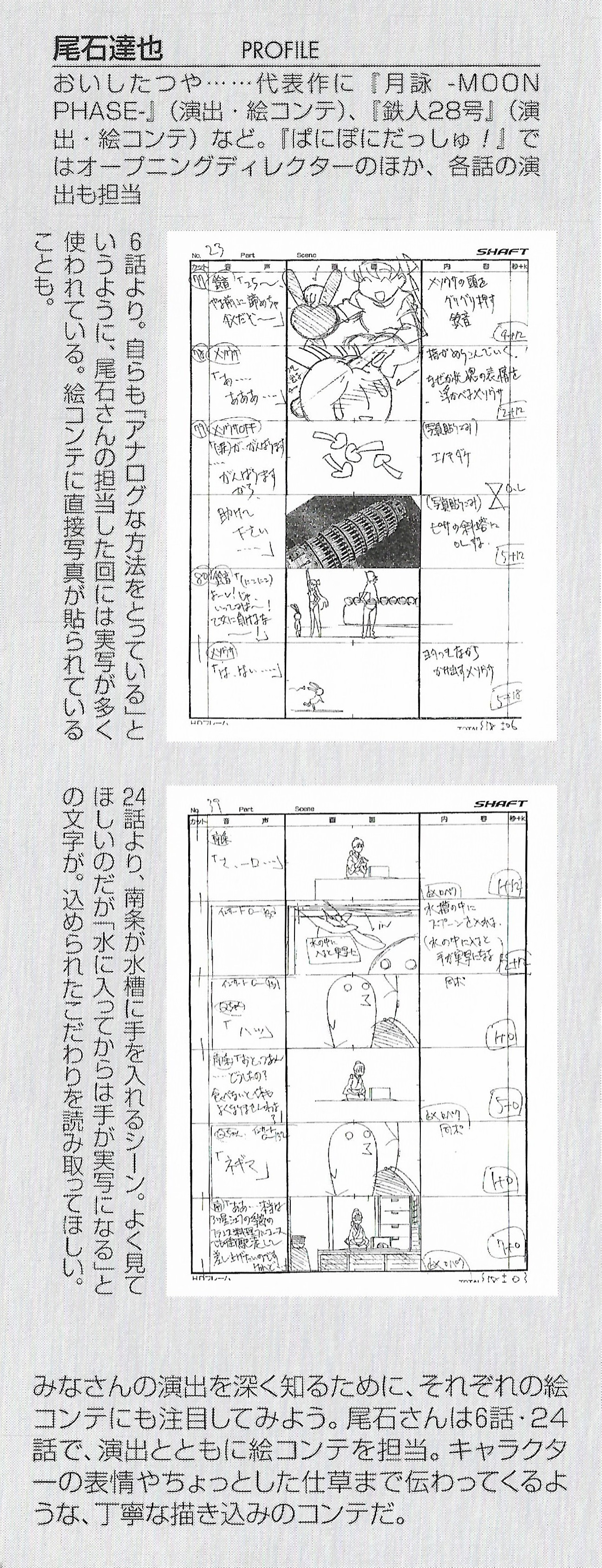
(Upper) From Episode 6. As Oishi-san says himself, “I’ve taken the analogue approach”, he uses a lot of real-life photos in his episodes. There are photos pasted directly onto the storyboard. (Lower) From Episode 24, the scene where Nanjo puts her hand in an aquarium. Please look the storyboard closer, and you’ll see the sentence “When entering water, the hand turns into a photo”. Hopefully you’ll be able to read the included details. In order to know better about the directors, please take attention to each storyboard presented here. Oishi-san was in charge of both directing and storyboarding Episodes 6 and 24. The storyboards are carefully drawn to convey characters’ expressions and even the smallest gestures. |
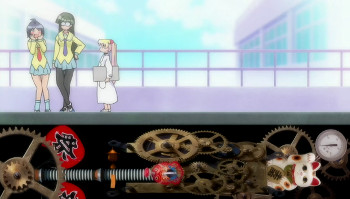 When watching episodes that Oishi-san was in charge of, you can sense a completely different atmosphere in them. To achieve something special no one but him could do, he went with an analogue style of directing, as a contrast to Oonuma-san and others. 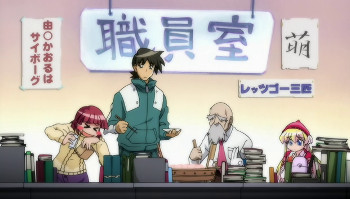 Apart from underground jokes (laughs), the episodes Oonuma-san were charge of have the characteristics of being fun and lively. Everyone in the staff of each episode, starting from animators, seemed to have a real blast when working. |
Shin Oonuma's Style Representative works: Tsukuyomi: Moon Phase (Direction, Storyboard), Hourglass of Summer (Direction, Storyboard) etc. Worked on Pani Poni Dash! as the Series Director, and overlooked the production of each episode. 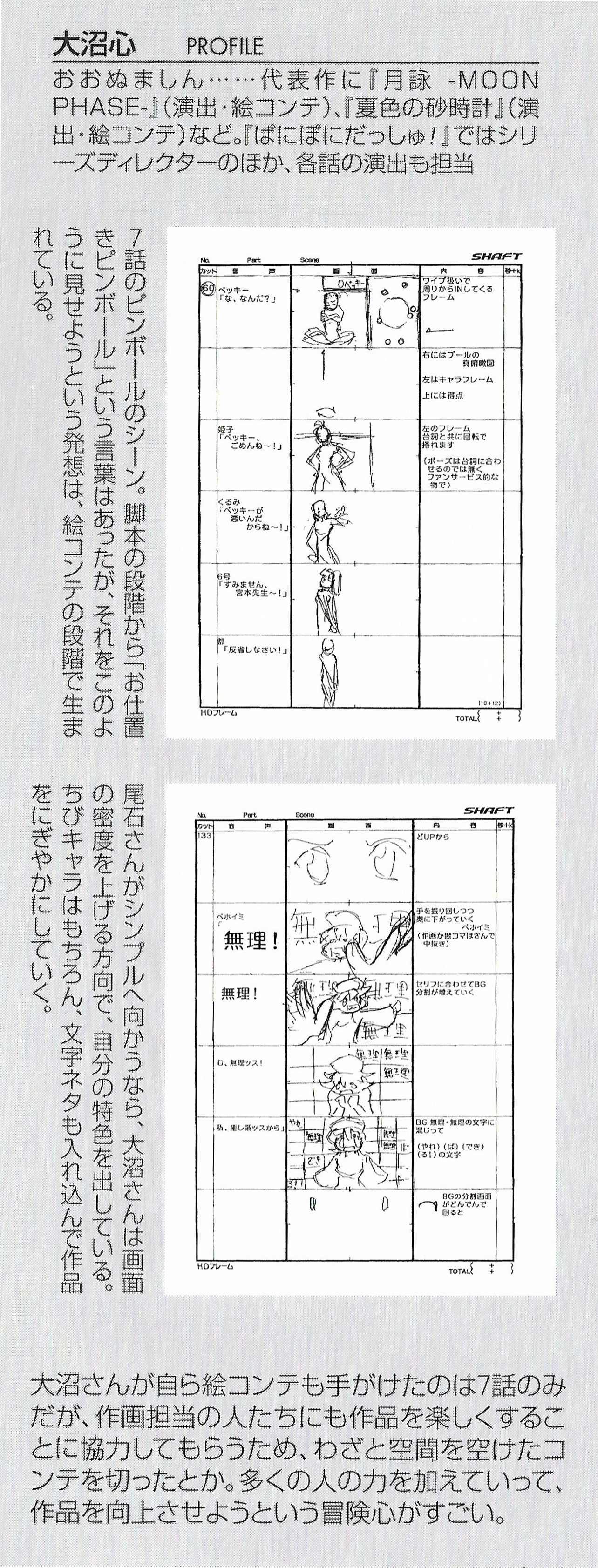
(Upper) Episode 7’s pinball scene. The words ”Punishment Pinball” were already on the script stage, but the idea of how to portray it was born on the storyboard stage. (Lower) While Oishi-san goes with a simple style, Oonuma-san increases the number of things in his scenes, which expresses his distinguishable style. Of course, the chibi characters, but also the incorporated jokes with letters make his episodes lively. The only storyboard Oonuma-san worked on was for Episode 7, but cut it full of empty spaces, and doing so, let the people in charge of animation cooperate together in order to make the episode more enjoyable. The adventurous spirit he shows with his style “the more people’s strength is included, the more the work improves”, is amazing. |
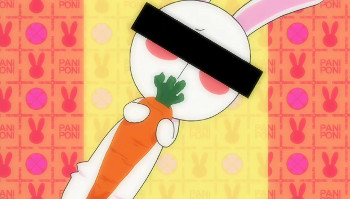 No matter what episode it is, Pani Poni is “Pani Poni”-like, as there’s a form of style that was clearly decided even before production. Especially the eyecatchers perform major roles. |
Yasuo Ejima's Style Representative works: School Rumble (Direction), Onegai My Melody (Direction, Storyboard), Spiral: The Bonds of Reasoning (Direction, Storyboard) etc. Overlooked the production of each Pani Poni Dash! episode.
(Upper) Storyboard with emphasis on characters’ feet and butt. According to Kazuhiko Oota-san, Noboru Jitsuhara-san is known for drawing “lewd” art, and since he was going to serve as the episode’s animation direction, it’s very likely these details were added with him in mind. (Lower) References to games aren’t exclusive to Oonuma-san’s episodes (laughs). As he himself said it, “in terms of directing, me and Oonuma-san may have the same artistic style”, which shows with storyboards being packed full of references. Ejima-san didn’t handle only the directing of Episode 15, but also its storyboard. His style is what Director Shinbo called as the “Quantity Strategy”, when there’s tons of jokes inserted in the storyboard. You’ll be able to feel not only the origins of jokes, but also their tempo, through these pretty lively scene creations. |
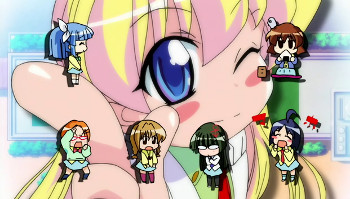 Even though it’s the Final Episode, “Goodbye” isn’t applied here, but rather “Good job”. This message isn’t directed only to staff and cast members, but also to the fans who watched the show to the end. 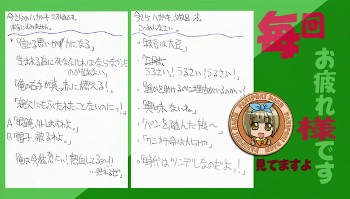 Showing these was a way to thank the people who applied blackboard scribbles for the anime through mail, and who promoted the anime on their homepages. This is actual proof of an ideal relationship built between the fans and the work. |
Continuation to The Way of Showing Pani Poni Dash!
We now have Michio Fukuda-san with us, who has been in charge of storyboards for a total of 8 episodes, including significant ones like the first and last episodes. We asked Fukuda-san to reminisce Pani Poni Dash! and tell what kind of a work it was to him. | |
|---|---|
The Theme of Pani Poni is Throwing Stuff Together!? | |
Please tell us about your memories with being in charge of producing Pani Poni Dash! | |
Fukuda | I had previously worked together with Director Shinbo on Tsukuyomi, where there were Drifters jokes and such, so when we began working on Pani Poni Dash!, I figured whether to continue doing like the way we were used to. That’s the story behind it. But this time around, I remember how one staff member suggested adding a TV crew in the anime. And as Oonuma-san’s strong points are game references and jokes, he told me “Please look forward to me showing off chibi characters and game status screens”. When we got Episode 1’s film up running and watched it, I remember how we were shocked as in “Woaah, we really overdid ourselves”. But that’s why at the production stage of Episode 1, we couldn’t predict what kind of a work “Pani Poni” would turn out to be. However, at the very beginning, I heard from Shinbo-san “Gag or not, just throw it in (laughs). Throwing stuff together without moderation is the theme of ‘Pani Poni’ ”. I find it funny how in his stance, he leaves throwing stuff together to us and watches our work with a smirk. |
Did you encounter any difficulties at the beginning of production? | |
Fukuda | Simply said, I had fun. Honestly though, when reading script for the very first time, there were some parts that I didn’t understand at all, but after speaking with Shinbo-san I was able to see what the script was aiming for, and there, I thought this would be a pretty interesting work. |
What kind of parodies did you include at the storyboard stage? | |
Fukuda | For example in Episode 16, there was a reference to The Isla*d. The one where the R sign drops down. Also, this is a bit off-topic from the question, but I keep in mind that these are not “knockoffs”, but “parodies”. After all, I wouldn’t have used works unless I respected them. |
The Uniqueness of Work’s Nonconsecutive Feel | |
Are there any specific episodes that have left you an impression? | |
Fukuda | Truth to be told, I don’t remember detailed things all that well. A normal work is like spatial art, which is something created with time carefully while imagining the finished product, but in the case of Pani Poni Dash!, it’s like time-based art, similar to music and performance arts. So even though there is a script, the flow of momentum and stimulus got from other works make the strongest element: creation with improvisation. You can’t decide whether doing this thing would be fine, if you don’t have improvisational mood going on (laughs). Creator’s mood differs greatly depending on the episode, but it’s not mood that changes; it’s that they switch between liking and not liking it. That’s why I don’t remember about stuff happened in past all that much. In that sense, I think that this session-like approach, where we go through every episode one by one without having to remember every detail, suits much better to a work like Pani Poni. |
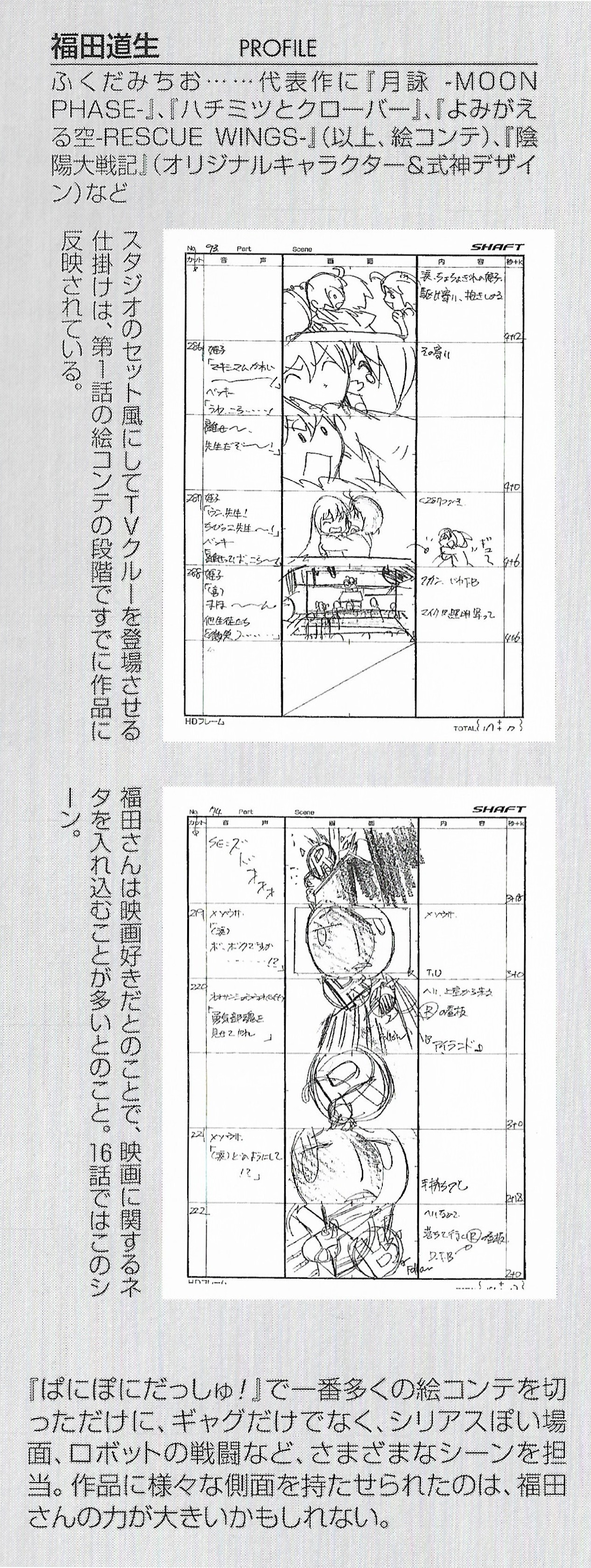 |
Michio Fukuda's Style Representative works: Tsukuyomi: Moon Phase, Honey and Clover, Yomigaeru Sora - Rescue Wings (Only Storyboards), Onmyō Taisenki (Original Character & Shikigami Design) etc. (Upper) The idea for creating a studio set with TV crew appearing was something that was already reflected on the stage of Episode 1’s storyboard. (Lower) Since Fukuda-san is a film enthusiast, there’s a lot of references concerning movies inserted in the show. This scene is from Episode 16. As he did most of the storyboards in Pani Poni Dash!, he wasn’t in charge of only the jokes, but also a variety of scenes, such as pretty serious parts and robot battles etc. Fukuda-san’s efforts may have played a large role in giving the anime various different aspects. |
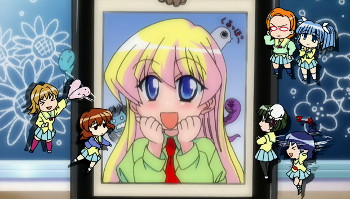 Episode 1, with its chibi characters moving all over the cramped screen, was the thing that got viewers hooked up right from the start. When the direction of the work was heading to that that wasn’t clearly grasped yet, Fukuda-san too was surprised to see what the storyboard became to be through editing. 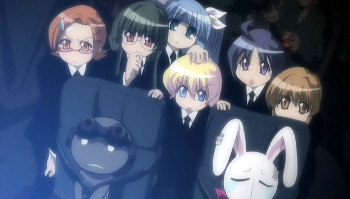 Fukuda-san’s impression was that ”It’s a work that could only have been made at that time, during that period, and when everyone involved were at that age”. Some of these parts may be connected to staff’s relationship towards each character, starting from Class C. |